
Lime harling, lime render and lime painting
Traditional lime harl, lime render and lime paint that protect rubble walls while letting them dry out, applied by hand and matched to the building.

What the work involves
Harling is the traditional Scottish finish for rubble walls: a mix of lime and aggregate thrown onto the wall. Lime render is applied with a trowel and finished smoother. Both protect the stone and its joints from driving rain while letting moisture escape. Our work includes:
- Removing failed or cement rendercarefully, without damaging the stone underneath
- Repairing and repointingthe masonry before new coats go on
- Applying lime coats by hand,built up in layers and protected while they cure
- Matching colour and textureto the building, with sample panels for approval
- Finishing in lime paintor a breathable mineral paint, so the wall can still dry out
Why lime, not cement
Cement render is hard and impermeable. On a solid stone wall it traps moisture, which then escapes through the stone instead, causing damp inside and frost damage outside. Lime harl and render are softer and let water vapour through, so the wall can dry out between showers. Modern masonry paints can seal a wall in the same way, which is why we finish lime in lime paint or a breathable mineral paint.
Before and after: The Jougs, Kilmaurs
 Before
 After
Related projects
All projects
The Tolbooth, West Wemyss
Cement harl removed and the masonry repaired for a new lime harl on a Category B listed tolbooth of about 1700.
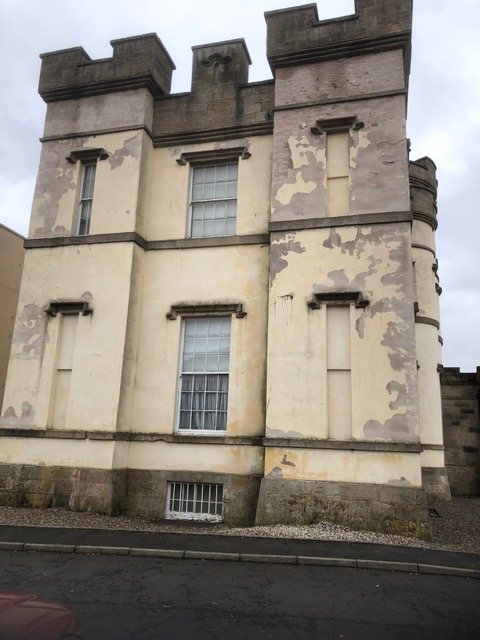
Smyllum House, Lanark
Defective render replaced with new lime render and a finish of lime paint.
The Jougs, Kilmaurs
Lime render, repointing, a rebuilt chimney stack and reclaimed Scottish slate.
Harling and render questions
What is the difference between harling and render?
Harling is a rough-cast finish: a wet mix of lime and aggregate is thrown onto the wall, giving the textured surface seen on many Scottish castles and houses. Render is applied with a trowel and finished smoother. Both can be made with lime.
Should cement render be removed from a stone building?
Often, if it is trapping damp or coming away, but it needs care because removing it can damage the stone underneath. We look at the wall first and agree the approach with you and, for a listed building, your planning authority.
When can lime harling be applied?
Lime needs mild, frost-free weather to cure, so harling is usually planned between spring and early autumn, with protection from sun, wind and rain while it sets.
Why finish lime render with lime paint?
Lime paints and mineral paints let water vapour through, so the wall can still dry out, whereas modern masonry paints can seal the surface and trap moisture behind it. At Smyllum House in Lanark the new lime render was finished in lime paint, and at Cranshaws Castle the lime harl was finished in Keim mineral paint.
Tell us about your building
Send a short description and a few photos. We will call you back to talk it through and, if it helps, arrange a site visit.
- Phone01620 861 683
- Emailinfo@gbrownstonemason.com
- OfficeStation Yard, East Linton, East Lothian